Showing posts with label Jennifer. Show all posts
Showing posts with label Jennifer. Show all posts
Thursday, June 7, 2007
BOB
Well, just in case, here is a BOB. So here we are again, at another end of a unit(s). Haha, well design and measurement, I don't really like much. Even though it's pretty simple, there's just so much to do, and the long word problems always tend to confuse me. It wasn't really a unit, hahah because we didn't spend too many classes on it, so I feel that I'm still very weak in that area. I wish we could've done more design and measurement problems. Sequences, I like this unit a lot better than design and measurement. Mr. K said that we could be asked two types of sequences question (like the fish question or the squares question) I feel more confident with the "fish type" questions. I hope I do good on the test, and I hope we all pass!! Goodluck everyone!


Wednesday, May 30, 2007
BOB
We're at the end of another unit again! This unit was okay. At the beginning it was pretty easy to understand... until we applied what we learned into word problems. Some word problems are easier than others, but I always have a problem approaching the problem and not knowing what I need to look for. I think all I really need to do is read the problem very carefully and idenitify what is given to me and what I need to solve. Bu overall, I guess this unit was quite easy and quick. I just hope I do good on the test!!!
Thursday, May 17, 2007
Periodic Functions
Bahahaha, I'm scribe again. Here's my post. It almost looks like Mr. K's slides from class! Hahaha =)
OHHH and the next scribe is TENNYSON!
OHHH and the next scribe is TENNYSON!
Monday, May 14, 2007
BOB
Hello! Well I think with this unit, I had some bad times and some good times. Hehe. Mortage, buying, and renting a house was my favorite things to work on. Leasing and buying a car, I didn't like that very much. And I don't have a very good reason to why I don't like the buying/leasing cars questions. Even though the mortage questions are LONG, like omg, it's still kind of fun to do! But there are still moments where I don't know how to approach a part of a question. But I hope that I'll do good on this "test". Goodluck everyone. Hahah 2 questions that are worth 1000 marks sounds scary!!!!! =)
Saturday, May 12, 2007
Personal Finance, May 11
Hello everyone. Well on Friday we had two classes! In the first class we worked on a quiz, and went over the answers. I'll take the slides and elaborate on some of the stuff that might be hard to understand, since there is only an image and no explanation.
So this was the first question on the quiz:

So for part A, it's simple. Just use the TVM solver. But the sneaky part is with the down payment. Be sure to subtract $4000 from the total price of the new car. The value that you get will be your [Present Value], then [Alpha][Solve] to get the monthly payment.
For part B, it's just as simple. the monthly payment for rent is $325, and she rents for 3 years. (you multiply 325x36=11700). Then you have to read carefully because it says that she wants to purchase the car afterwards, and that will cost $8000. So you just add the $8000 to $11700.
For part C, they are asking which is the better deal. To figure that out take the monthly payments of buying, and multiply that by 36, then you must remember to add the $4000 down payment. That will give you the TOTAL AMOUNT PAID FOR BUYING THE HOUSE. Since there are no down payments to renting the answer you got in part B is the TOTAL AMOUNT PAID FOR RENTING. Then you compare the total costs, and the smaller value is always the best one! And subtract them from each other to find how much she saved.
And the second question...

We wanted to find out how much her tractor will be worth after 6 years. There are a few ways that you can approach this question.
One way, which is the hard way, is to multiply $60000 by 8% and subtract that answer from $60000, then take that result and multiply it by 8%, then subtract again.
The second way that you can do this question is just multiply $60000 by 92% (because the tractor depreciates by 8% which means that you're KEEPING 92%), and just multiply that for every year, until six years.
The third way, you can do this question is by taking $60000 and multiply it by 92%, but then remember to raise it to the power of 6, since you want to know how much it is worth after 6 years.
And the next question...

This question was pretty straight forward. It gives you the monthly payment ($500), the interest rate (4%), how many times it's compounded (12), and it tells you when he makes payments (at the beginning of every three months, which is 4 times a year).
Just put it into your TVM solver, but the tricky part is when they say " at the BEGINNING of every 3 months". Look at where it says "PMT: END BEGIN" on the TVM solver. You have to put it on BEGIN in order to get the right answer!
AFTER THE QUIZ.. we went back to the question we worked on the previous day.
THIS WAS ALL OF OUR INFORMATION FROM THE QUESTION.

Then we worked on part D
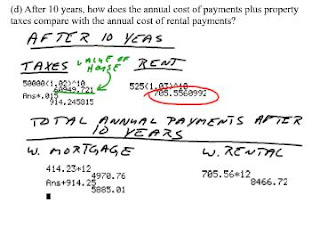
So after 10 years, the value of the house is worth $60949.72. You multiply the value of the home by the percent that it appreciates, so that's 50000(1.02), then raise it to the power of ten because you want to know how much its worth after 10 years. To get the taxes multiply it by 0.015 because the question said that the taxes are 1.5% of the market value.
For renting, its just the monthly payments multiplied by how much it appreciates each month. In this case, the monthly payments are 525, and it is appreciating by 3%.
And to get the TOTAL ANNUAL PAYMENT after 10 years, if you are buying the house, you take the monthly payments, which we found in part a, and you multiply it by 12 (one year) then ADD the taxes. and you get $5885.01
And if you are renting, just multiply how much renting costs after 10 years which we got earlier, and multiply it by 12. and you get $8466.72
PART E asked:

They might want to rent instead of buy, even though it is more expensive because of the following reasons:
- when buying, the heating, hydro, electricity, and other expenses were not yet included. So that would mean more money for more expenses. Where as in renting you already have the heating and hydro, etc included in those monthly payments. - the family would probably rent, depending on their financial situation as well. They probably don't have the money up front to pay for the down payment if they wanted to buy a house.
AFTER THAT QUESTION, we moved on to another long question

But it wasn't all that bad. Here are the answers and explanations:

AND THAT IS ALL!!! Tomorrow is our "test". Two questions that are worth 1000 MARKS! Goodluck guys. See you tomorrow!
And the next scribe will be.... NAYDIA!!!!
So this was the first question on the quiz:

So for part A, it's simple. Just use the TVM solver. But the sneaky part is with the down payment. Be sure to subtract $4000 from the total price of the new car. The value that you get will be your [Present Value], then [Alpha][Solve] to get the monthly payment.
For part B, it's just as simple. the monthly payment for rent is $325, and she rents for 3 years. (you multiply 325x36=11700). Then you have to read carefully because it says that she wants to purchase the car afterwards, and that will cost $8000. So you just add the $8000 to $11700.
For part C, they are asking which is the better deal. To figure that out take the monthly payments of buying, and multiply that by 36, then you must remember to add the $4000 down payment. That will give you the TOTAL AMOUNT PAID FOR BUYING THE HOUSE. Since there are no down payments to renting the answer you got in part B is the TOTAL AMOUNT PAID FOR RENTING. Then you compare the total costs, and the smaller value is always the best one! And subtract them from each other to find how much she saved.
And the second question...

We wanted to find out how much her tractor will be worth after 6 years. There are a few ways that you can approach this question.
One way, which is the hard way, is to multiply $60000 by 8% and subtract that answer from $60000, then take that result and multiply it by 8%, then subtract again.
The second way that you can do this question is just multiply $60000 by 92% (because the tractor depreciates by 8% which means that you're KEEPING 92%), and just multiply that for every year, until six years.
The third way, you can do this question is by taking $60000 and multiply it by 92%, but then remember to raise it to the power of 6, since you want to know how much it is worth after 6 years.
And the next question...

This question was pretty straight forward. It gives you the monthly payment ($500), the interest rate (4%), how many times it's compounded (12), and it tells you when he makes payments (at the beginning of every three months, which is 4 times a year).
Just put it into your TVM solver, but the tricky part is when they say " at the BEGINNING of every 3 months". Look at where it says "PMT: END BEGIN" on the TVM solver. You have to put it on BEGIN in order to get the right answer!
AFTER THE QUIZ.. we went back to the question we worked on the previous day.
THIS WAS ALL OF OUR INFORMATION FROM THE QUESTION.

Then we worked on part D

So after 10 years, the value of the house is worth $60949.72. You multiply the value of the home by the percent that it appreciates, so that's 50000(1.02), then raise it to the power of ten because you want to know how much its worth after 10 years. To get the taxes multiply it by 0.015 because the question said that the taxes are 1.5% of the market value.
For renting, its just the monthly payments multiplied by how much it appreciates each month. In this case, the monthly payments are 525, and it is appreciating by 3%.
And to get the TOTAL ANNUAL PAYMENT after 10 years, if you are buying the house, you take the monthly payments, which we found in part a, and you multiply it by 12 (one year) then ADD the taxes. and you get $5885.01
And if you are renting, just multiply how much renting costs after 10 years which we got earlier, and multiply it by 12. and you get $8466.72
PART E asked:

They might want to rent instead of buy, even though it is more expensive because of the following reasons:
- when buying, the heating, hydro, electricity, and other expenses were not yet included. So that would mean more money for more expenses. Where as in renting you already have the heating and hydro, etc included in those monthly payments. - the family would probably rent, depending on their financial situation as well. They probably don't have the money up front to pay for the down payment if they wanted to buy a house.
AFTER THAT QUESTION, we moved on to another long question

But it wasn't all that bad. Here are the answers and explanations:

AND THAT IS ALL!!! Tomorrow is our "test". Two questions that are worth 1000 MARKS! Goodluck guys. See you tomorrow!
And the next scribe will be.... NAYDIA!!!!
Thursday, April 26, 2007
BOB
I thought that Vectors was kind of confusing at the beginning, but I've learned how to understand it more by reading the questions extra carefully. There are still some questions that confuse me, but I think that it'll be okay. Before the test, I did a whole bunch of questions from the textbook, and like Mr.K said, we're just doing the same question over and over again. I feel like I'm ready for the test. But I really don't like questions with three vectors. Hehe, goodluck on the test everyone! I hope I get a good mark!
Tuesday, April 10, 2007
BOB
Hello! So I think... I THINK we have to BOB. I'm not too sure, but I'll write a BOB tonight just in case our stats test is tomorrow! Well statistics was a very long and hard unit! I feel confident in some areas of statistics, but not all. I feel like I'm most confident with z-scores, and the 95% confidence level. The other topics just confuse me sometimes. I really have a hard time approaching the question, and figuring out which function to use on my calculator! normalpdf, normalcdf, binompdf, binomcdf, invnorm!!??! But I'm trying to do many different problems so that I could understand it more. And it's working! And I HOPE I get a good mark on the test! .. if our test is tomorrow!
Monday, April 2, 2007

Monday, March 19, 2007
March 19, 2007
I hope you guys enjoy this! It was fun. hehe ^_____^
And the next scribe is...... NADIYA!
And the next scribe is...... NADIYA!
Tuesday, March 6, 2007
BOB
Well, our test is coming up soon. Probability... I never really liked that unit, even when I was in elementary! But anyways, when we started probability I had no clue of what I was doing. I started to catch on when we took things a little slowly. Then we went all fast again! Then I was lost. But we're doing a lot of questions, and I feel like I'm learning from that. Well I hope I am =) The only thing that scares me and I feel like I really need more time on is the Mutually Exclusive events. And I still have troubles learning how to approach certain questions. But I'll study hard, and LOOK OVER ALL MY NOTES! And I'll study off of our blog. I'm pretty sure it'll help. OKAY BYE!
Sunday, February 18, 2007
BOB
Well we're at the end of our matrices unit. I was confused and lost at the beginning of the unit, but now it all makes sense. When we first started, I felt that adding and subtracting matrices was quite easy, then when we started to multiply matrices, and when we started to work with transitions matrices I was STUCK. But as our class worked together and asked questions, I started to get the hang of those transition matrices. And I LOVED how honest my classmates were when we didn't understand something.
Mr. K : Am I making sense to you guys? Or should I run that by you again?
Students: Nope!! We don't get it. Run that by us again.
Well now that I understand the things that we're doing I hope I get a good mark on this test. I really want to do well in this course. Okay. BYE BYE!!!
Mr. K : Am I making sense to you guys? Or should I run that by you again?
Students: Nope!! We don't get it. Run that by us again.
Well now that I understand the things that we're doing I hope I get a good mark on this test. I really want to do well in this course. Okay. BYE BYE!!!
Thursday, February 8, 2007
Network Matrices
Today in class we talked about NETWORK MATRICES. These matrices are used in the real world. Whether it is cables between computers, wries between telephones, railway networks, airplane routes between major centers, there is always a connection between places and things.
Connections may be achieved by "one-hop", "two-hop", "three-hop", "four-hop", etc.
I'll use airplanes as an example.
A "one-hop" is a direct connection between the two cities.
ex: one airplane trip (one hop) from Atlanta to Boston
A "two-hop" is the 2 different ways from one city to another with 2 different airplanes.
ex: one airplane trip (one hop) from Atlanta to Boston then another airplane trip (2 hop) either back to Atlanta, or Charlotte.
A "three-hop" is the 3 different ways from one city to another with 3 different airplanes.
ex: one airplane trip (one hope) from Atlanta to Boston, then another airplane trip (2 hop) to Charlotte, then another airplane trip (3 hop) back to Atlanta.
And so on...
For example:

We can create a "connectivity matrix" showing the direct routes of the network on the left side of this page.
We can create a matrix that represents the connection between A, B, and C. In this matrix we will need 3 rows and 3 columns.
When there is one direct route, you place a "1" in any cell which indicates a direct connection between two places. For example there is one route from A to B, so a "1" could go into the cell that connects A to B. When there is an indirect route, you place a "0" in any cell which indicates no direct connection. In this case, there is no route from A to C, so therefore in the cell that connects A to C, you would place a "0"
The matrix for the image above should be:

We also learned how to indicate where there is a "2 hop" route between places. In our example, is there a 2 hop route between A and A? YES! Because you are able to take a plane to Boston, and take another plane back to Atlanta. So in a matrix that indicates "2 hops", you'd place a "1" showing that there is a "2 hop" route between A and A. In our case, there is no 2 hop route from A to B. Because there is a plane that takes you from A to B, but the next plane will take you somewhere else besides B. So you'd place a "0" in the cell connecting A and B for "2 hops"
The matrix indicating "2 hop" routes should look like this:

Whatever number a connectivity matrix is raised to, will tell you how many different routes there are.
For example, if the connectivity matrix is raised to the power of 2, the result of that would tell us the number of ways from one place to another with 2 airplanes.
If the connectivity matrix is raised to power of 3, the result of that would tell us the number of ways from one place to another with 3 airplanes. ETC.
And tomorrow's scribe is....... JHAY-AR!!
Subscribe to:
Posts (Atom)


