Showing posts with label Cris. Show all posts
Showing posts with label Cris. Show all posts
Thursday, April 26, 2007
BOB
i can't believe that there's only a month left this school year, sweet ! Well vector unit is not really that hard, you just have to understand what the question says and if you do everything should be fine because we do same calculation for each one all the time. I hope I'll do good on the test. Good luck to you guyz.


Wednesday, April 18, 2007
Scribe
Hello guys, sorry that my scribe is a little late. This is the scribe for yesterday's and monday's class.
 Parallelogram


Connect both vectors to get the resultant vector. Like this.

Adding Vector
A vector is represented by directed line segments. The arrwohead indicates the direction of the vector, and the length of the segment indicates its magnitude.
A geometric vector has two components: the magnitude or the length of the vector and the direction in which the vector acts.
ParallelogramWhen two vectors are acting on the same point, the are arranged tail to tail, they can be added using the parallelogram method of addition.
For Example:

You have a 3 cm vector facing to east and a 4 cm vector facing south.

Copy each vectors and put them on the opposite side of the original vectors, but still facing on the same direction.

The diagonal line is called the resultant vector. Measure it to get the answer.
If you did all the measurements correctly, your answer should be 5 cm.
Triangle Method
When two vectors are arranged sequentially, they are haed to tail, this vectors can be added using the triangle method of addition.
For Example:

There is a 3 cm vector facing east and a 4 cm vector facing north and they're connected tail -to- head.

Connect both vectors to get the resultant vector. Like this.
If you also did all the measurements right, your must be 5 cm.
When adding vectors, you must indicate the length of the resultant vector and an angle with the direction, or you can also use a bearing for your final answer.

You can use the compass directions to guide you in getting the angle you're looking for.
When you got the resultant vector and the angle your answer should look something like this:
5 cm at 42 degrees North of East
That is the end of my scribe. The next scribe is Brittany !
Wednesday, April 11, 2007
BOB
Just like others said, Statistics was really a hard unit. There where a lot of times that I don't even know what to do or I could not follow the steps that we have to do on the calculator, but in the end it was okay. For me to pass this upcoming test, I really need to study. I think the key to pass this test is to know what formula to use on a certain question and to understand the question itself. Like everybody else said, this is really a confusing unit, so good luck to you guys. I hope we all do well.
Thursday, April 5, 2007

Wednesday, March 14, 2007
March 14, 2007
Happy Pi Day to everyone. To start things off, here some facts about Pi Day.

March 14, written as 3-14 or 3/14 in the United States date format, represents the common three-digit approximation for the number π: 3.14. Pi Day is often celebrated at 1:59 p.m. in recognition of the six-digit approximation: 3.14159. Some, using a 24-hour clock, celebrate it at 1:59 a.m. or 3:09 p.m. (15:09) instead.
Pies for a celebration at the Massachusetts Institute of Technology
Pi Day is celebrated in a variety of ways. Parties or other observances may be held by mathematics departments in educational institutions. Harvard's Math department, for instance, has a pi recitation contest as well as a pi eating contest. Mathematics or science clubs might gather to consider the role that the number π has played in their lives and to imagine the world without π. During such an event, pi celebrants may approximate π, devise alternative values for π, eat pie, play piñata, drink Piña Colada, eat pizza, listen to the song "Pi" by Kate Bush, watch Pi, or recite Pi. The song 867-5309/Jenny is sometimes sung, replacing the digits with the first several digits of pi. The shape of the pie is sometimes square, due to the pronunciation of the equation for the surface area bounded by a circle = πr2, i.e., "pie are squared."
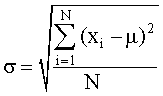 WHERE:

March 14, written as 3-14 or 3/14 in the United States date format, represents the common three-digit approximation for the number π: 3.14. Pi Day is often celebrated at 1:59 p.m. in recognition of the six-digit approximation: 3.14159. Some, using a 24-hour clock, celebrate it at 1:59 a.m. or 3:09 p.m. (15:09) instead.
Pies for a celebration at the Massachusetts Institute of Technology
Pi Day is celebrated in a variety of ways. Parties or other observances may be held by mathematics departments in educational institutions. Harvard's Math department, for instance, has a pi recitation contest as well as a pi eating contest. Mathematics or science clubs might gather to consider the role that the number π has played in their lives and to imagine the world without π. During such an event, pi celebrants may approximate π, devise alternative values for π, eat pie, play piñata, drink Piña Colada, eat pizza, listen to the song "Pi" by Kate Bush, watch Pi, or recite Pi. The song 867-5309/Jenny is sometimes sung, replacing the digits with the first several digits of pi. The shape of the pie is sometimes square, due to the pronunciation of the equation for the surface area bounded by a circle = πr2, i.e., "pie are squared."
It's unclear when Pi Day was first celebrated. The Exploratorium began an annual public celebration of Pi Day in 1987, with staff and public marching around one of its circular spaces, and then consuming fruit pies; the museum has since added pizza pies to its Pi Day menu.
Enthusiasts also note that the day happens to be Albert Einstein's birthday, among other famous birthdays on this day. Massachusetts Institute of Technology, known for its sometimes unconventional and quirky take on mathematics, often mails out its acceptance letters to be delivered to prospective students on Pi Day.
Enthusiasts also note that the day happens to be Albert Einstein's birthday, among other famous birthdays on this day. Massachusetts Institute of Technology, known for its sometimes unconventional and quirky take on mathematics, often mails out its acceptance letters to be delivered to prospective students on Pi Day.
Wikipedia.
We started our morning class by celebrating Pi Day. I felt bad on eating all those pies that I ate because I did not bring any. Anyways, besides eating lots of pies and drinking milk/chocolate milk, Mr. K also told us about the rubric for the "Developing Expert Voices" and "FlickR" assignments.
*Rubric is basically a method and tool for grading assignments
In our afternoon class, we discussed Measures of Variability. We talked about Range, Mean, Standard Deviation, etc.
Range - the difference between the largest and smallest value in a set of data.
Mean - the sum of the observations divided by the number of observations.
Standard Deviation - measures how widely spread the values in a data set are.
We started the last period by listing everyone's age on the smart board.
These are the results:
highest value: 19
lowest value: 16
Range: 3 (19-16)
Then we calculate the data using this procedures:
*press STAT, 1. EDIT, the put the values on list one.
*after putting all the values, press 2ND, MODE to quit.
*press STAT, →, 1. VARS STAT.
*press 2ND, 1 to calculate the values on list one.

Standardard Deviation(σ) = .9823
If the Mean Average is 17.6875 and the Standard Deviation is equal to .9823, it means that our age difference is not too far from each other.
Mr. K also introduced to us the Standard Deviation Formula.
 WHERE:
x = individual score
μ = population mean
n = number of scores
Σ = means "the sum of"
That's all for me folks. Happy Pi Day, again.
the next scribe is Ivy
Wednesday, March 7, 2007
BOB
We are almost done in our probability unit, but Mr. K thinks that we are not ready, yet for the upcoming test. I think this is one of the hardest unit that I have ever taken. In this unit, Mr. K introduced few formulas that we can use. He said that in this unit we can't just rely on formulas to solve this problems. He said that we should not have a mechanical thinking on any of the problems. He said that we should learn how to understand what each number represents in the question, not just putting them all in the formula. Well, there are still a lot of things involved in this unit, but I think this is one of the most important thing we have to remember to do well on the test. I hope our next unit will be a lot easier than this one.
Monday, February 19, 2007
BOB
Oops i almost forgot to write my BOB.
I think the Matrix unit is not really a hard one, but it is tricky. The part where i had problems was the transition matrix. It's kinda confusing at the beginning, but the grouping thing really helped even though I like working alone, much. That's all, good luck on the test !
I think the Matrix unit is not really a hard one, but it is tricky. The part where i had problems was the transition matrix. It's kinda confusing at the beginning, but the grouping thing really helped even though I like working alone, much. That's all, good luck on the test !
Friday, February 16, 2007
February 15, 2007
In today's class we just worked on another question about transition matrices. Mr. K did not teach us any new stuff today, so I am just going to answer one of our assignment from the other day.
page 83, #4
4.If Regan passes his math test, the probability that he will pass the next one is 97%. If he fails his math test, the probability that he will pass the next on is only 85%. Regan has worked hard on this unit so the probability that he will pass the first test is 95%.
a) Write the initial probability matrix and the transition matrix.

b) What is the probability that Regan will pass the fifth test.
[S] x [T]^5 = [.97 .03] (therefore Regan has a 97% on passing his fifth test and 3% on failing it)
I did not show my work because I know that you guys already know how to answer this kind of question.
We also talked about the up coming project on matrix. Mr. K just show us the different kind of presentation we can choose from. If you missed the class that day or you just want to know more about it, just visit our blog and read the post "PRESENTATIONS ......".
This is the end of my scribe.
The next scribe is Jowell
Subscribe to:
Posts (Atom)


