Well I figured I would BOB about the sequences and the design and measurement "tests". I don't know what it is about Design and measurement but it does not make me nervous, sometimes I do well on it other times I don't. Its pretty easy as long as you know how to find area, perimeter, surface area, etc as well as knowing your metric systems. The only thing I didn't like about the unit is that it was so fast and we never really got a chance to go over much of it as a class until the assessment came about. But it helped!:)
For some reason I understood sequences at the beginning of the unit when we started talking about it lots, but once we got past the the find the nth term I started to get confused. Once that happened I started to question my abilities in the unit I understood it but didn't at the same time I didn't. Maybe because its the end of the year and eberythings getting"CRAZY", with all the different assignments and stress about the provincials. Well we'll see what happens On the provincial I really want to do well.
-Britt <3
Showing posts with label Personal Finance. Show all posts
Showing posts with label Personal Finance. Show all posts
Sunday, June 10, 2007
Monday, May 14, 2007
BOB
Personal finance is not a hard unit. We just have to read and understand the problems. This unit helped me learnned about the real world for example, in buying a car or house, or if buying is better than renting, etc. It gave me idea on what to do in the future if I'm in the same situation in the problems that we did in class. I think know what to do. I didn't have that much difficulty during this unit. Hope I did good... =/
bOb
Personal Finance_____one of the easiest unit that i've encountered....all you have to do is to read the question carefully and do a little thinking to solve the problem and i've also learned lots of things on this unit like the difference of buying and leasing a car, advantages and disadvantages and the mortage in buying a house and the most interesting part that I liked on this unit is on how you going to retire a millionaire.....
B o B
Personal Finance is almost finished. I really learned a lot of things from this unit that I could use in the real world. It helped me understand many things I didn't knew before, like the difference between leasing and buying a car, and mortgage. I also learned how to retire a millionaire...
Well, our 2 questions test is today, I just hope it's not too long and confusing...Good Luck! ~(_8^(])
Well, our 2 questions test is today, I just hope it's not too long and confusing...Good Luck! ~(_8^(])
BOB
PERSONAL FINANCE.... Was fun. It was one of the easiest units for me. I think. It was pretty much straight forward. All you have to do is read and think, read and think... READ AND THINK! ahaha. I really liked it, and i learned how to become a millionare if i live to be 60 ( i say if cause of cancers and other things that, yea ) . I hope i do really well on the test. The only thing im not looking forward to is the questions being long. Super long. GOOD LUCK EVERYONE!
Bob
Well we have reached another time for blogging. This unit went by pretty fast and even though there was a lot packed into it, it wasn't that hard. I think if you read the questions carefully then you should have no problem finding the answers. I think the mortgage part of this unit was the hardest because out of one mortgage question you could be asked to answer anything we have learned. Good luck to everyone on the mini test today.
B.O.B
Its our test today and i don't know if im ready. Maybe, maybe not. Our personal finance unit was interesting. We learned many thing about saving money to buying houses. I seriously did not know the things connected with buying a house before. What can i say, this unit was pretty interesting. It also got me thinking about what Mr K always mentioned to us about saving our money now and becoming a millionaire in the future. I hope this test is easy because its worth like 1000! marks whoa..Well, good luck everyone!
BOB
hey everyone, so it is the day of the test, i think it is going to be fun. I thought that this until was really fun to do. Not saying that I got evey question right, I'm saying that it is fun becuase you can acutally use what you learned from this unit in the future. I think that everyone is going to do good on the test, like hello you are allowed to bring in a cheat sheet. So Good Luck everyone, and make sure that what is on your cheat sheet is useful, dont fill it up with non sence it will just make it harder to understand.
BOB
Hello! Well I think with this unit, I had some bad times and some good times. Hehe. Mortage, buying, and renting a house was my favorite things to work on. Leasing and buying a car, I didn't like that very much. And I don't have a very good reason to why I don't like the buying/leasing cars questions. Even though the mortage questions are LONG, like omg, it's still kind of fun to do! But there are still moments where I don't know how to approach a part of a question. But I hope that I'll do good on this "test". Goodluck everyone. Hahah 2 questions that are worth 1000 marks sounds scary!!!!! =)
BOB on Personal Finance
Well, well, Personal Finance is almost over! I feel okay with this unit since I kind of did good on our quiz last friday. I think I just need to read the question carefully because sometimes I go too far for my answer when I actually don't need to do that, for short MISUNDERSTANDING THE QUESTION. Hopefully I will not do that on our test, because if I did! I'm going to beat up myself! I just really hate it when it comes to a long problem solving, and those sentences that can really twist my brain. Atleast in this unit I learned about financing now I'm pretty confident to buy a car, house, our anything else that relates about finance, because right about now I know what to do and no bank can fool me.
Sunday, May 13, 2007
wow i really enjoy this unit Personal Finance. Love this alot. I did bad on the quiz but didn't expect to do bad, but i've learn what is coming next. Just got read more clearly next time. i kind of picture myself doing Personal Finance for a living , i don't know just like the whole solution thing. well good luck guyz for the so Called " 1000 mark" test or assignment. lol by3
Saturday, May 12, 2007
Personal Finance, May 11
Hello everyone. Well on Friday we had two classes! In the first class we worked on a quiz, and went over the answers. I'll take the slides and elaborate on some of the stuff that might be hard to understand, since there is only an image and no explanation.
So this was the first question on the quiz:

So for part A, it's simple. Just use the TVM solver. But the sneaky part is with the down payment. Be sure to subtract $4000 from the total price of the new car. The value that you get will be your [Present Value], then [Alpha][Solve] to get the monthly payment.
For part B, it's just as simple. the monthly payment for rent is $325, and she rents for 3 years. (you multiply 325x36=11700). Then you have to read carefully because it says that she wants to purchase the car afterwards, and that will cost $8000. So you just add the $8000 to $11700.
For part C, they are asking which is the better deal. To figure that out take the monthly payments of buying, and multiply that by 36, then you must remember to add the $4000 down payment. That will give you the TOTAL AMOUNT PAID FOR BUYING THE HOUSE. Since there are no down payments to renting the answer you got in part B is the TOTAL AMOUNT PAID FOR RENTING. Then you compare the total costs, and the smaller value is always the best one! And subtract them from each other to find how much she saved.
And the second question...

We wanted to find out how much her tractor will be worth after 6 years. There are a few ways that you can approach this question.
One way, which is the hard way, is to multiply $60000 by 8% and subtract that answer from $60000, then take that result and multiply it by 8%, then subtract again.
The second way that you can do this question is just multiply $60000 by 92% (because the tractor depreciates by 8% which means that you're KEEPING 92%), and just multiply that for every year, until six years.
The third way, you can do this question is by taking $60000 and multiply it by 92%, but then remember to raise it to the power of 6, since you want to know how much it is worth after 6 years.
And the next question...

This question was pretty straight forward. It gives you the monthly payment ($500), the interest rate (4%), how many times it's compounded (12), and it tells you when he makes payments (at the beginning of every three months, which is 4 times a year).
Just put it into your TVM solver, but the tricky part is when they say " at the BEGINNING of every 3 months". Look at where it says "PMT: END BEGIN" on the TVM solver. You have to put it on BEGIN in order to get the right answer!
AFTER THE QUIZ.. we went back to the question we worked on the previous day.
THIS WAS ALL OF OUR INFORMATION FROM THE QUESTION.

Then we worked on part D
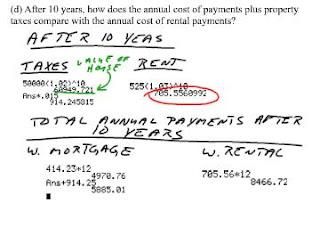
So after 10 years, the value of the house is worth $60949.72. You multiply the value of the home by the percent that it appreciates, so that's 50000(1.02), then raise it to the power of ten because you want to know how much its worth after 10 years. To get the taxes multiply it by 0.015 because the question said that the taxes are 1.5% of the market value.
For renting, its just the monthly payments multiplied by how much it appreciates each month. In this case, the monthly payments are 525, and it is appreciating by 3%.
And to get the TOTAL ANNUAL PAYMENT after 10 years, if you are buying the house, you take the monthly payments, which we found in part a, and you multiply it by 12 (one year) then ADD the taxes. and you get $5885.01
And if you are renting, just multiply how much renting costs after 10 years which we got earlier, and multiply it by 12. and you get $8466.72
PART E asked:

They might want to rent instead of buy, even though it is more expensive because of the following reasons:
- when buying, the heating, hydro, electricity, and other expenses were not yet included. So that would mean more money for more expenses. Where as in renting you already have the heating and hydro, etc included in those monthly payments. - the family would probably rent, depending on their financial situation as well. They probably don't have the money up front to pay for the down payment if they wanted to buy a house.
AFTER THAT QUESTION, we moved on to another long question

But it wasn't all that bad. Here are the answers and explanations:

AND THAT IS ALL!!! Tomorrow is our "test". Two questions that are worth 1000 MARKS! Goodluck guys. See you tomorrow!
And the next scribe will be.... NAYDIA!!!!
So this was the first question on the quiz:

So for part A, it's simple. Just use the TVM solver. But the sneaky part is with the down payment. Be sure to subtract $4000 from the total price of the new car. The value that you get will be your [Present Value], then [Alpha][Solve] to get the monthly payment.
For part B, it's just as simple. the monthly payment for rent is $325, and she rents for 3 years. (you multiply 325x36=11700). Then you have to read carefully because it says that she wants to purchase the car afterwards, and that will cost $8000. So you just add the $8000 to $11700.
For part C, they are asking which is the better deal. To figure that out take the monthly payments of buying, and multiply that by 36, then you must remember to add the $4000 down payment. That will give you the TOTAL AMOUNT PAID FOR BUYING THE HOUSE. Since there are no down payments to renting the answer you got in part B is the TOTAL AMOUNT PAID FOR RENTING. Then you compare the total costs, and the smaller value is always the best one! And subtract them from each other to find how much she saved.
And the second question...

We wanted to find out how much her tractor will be worth after 6 years. There are a few ways that you can approach this question.
One way, which is the hard way, is to multiply $60000 by 8% and subtract that answer from $60000, then take that result and multiply it by 8%, then subtract again.
The second way that you can do this question is just multiply $60000 by 92% (because the tractor depreciates by 8% which means that you're KEEPING 92%), and just multiply that for every year, until six years.
The third way, you can do this question is by taking $60000 and multiply it by 92%, but then remember to raise it to the power of 6, since you want to know how much it is worth after 6 years.
And the next question...

This question was pretty straight forward. It gives you the monthly payment ($500), the interest rate (4%), how many times it's compounded (12), and it tells you when he makes payments (at the beginning of every three months, which is 4 times a year).
Just put it into your TVM solver, but the tricky part is when they say " at the BEGINNING of every 3 months". Look at where it says "PMT: END BEGIN" on the TVM solver. You have to put it on BEGIN in order to get the right answer!
AFTER THE QUIZ.. we went back to the question we worked on the previous day.
THIS WAS ALL OF OUR INFORMATION FROM THE QUESTION.

Then we worked on part D

So after 10 years, the value of the house is worth $60949.72. You multiply the value of the home by the percent that it appreciates, so that's 50000(1.02), then raise it to the power of ten because you want to know how much its worth after 10 years. To get the taxes multiply it by 0.015 because the question said that the taxes are 1.5% of the market value.
For renting, its just the monthly payments multiplied by how much it appreciates each month. In this case, the monthly payments are 525, and it is appreciating by 3%.
And to get the TOTAL ANNUAL PAYMENT after 10 years, if you are buying the house, you take the monthly payments, which we found in part a, and you multiply it by 12 (one year) then ADD the taxes. and you get $5885.01
And if you are renting, just multiply how much renting costs after 10 years which we got earlier, and multiply it by 12. and you get $8466.72
PART E asked:

They might want to rent instead of buy, even though it is more expensive because of the following reasons:
- when buying, the heating, hydro, electricity, and other expenses were not yet included. So that would mean more money for more expenses. Where as in renting you already have the heating and hydro, etc included in those monthly payments. - the family would probably rent, depending on their financial situation as well. They probably don't have the money up front to pay for the down payment if they wanted to buy a house.
AFTER THAT QUESTION, we moved on to another long question

But it wasn't all that bad. Here are the answers and explanations:

AND THAT IS ALL!!! Tomorrow is our "test". Two questions that are worth 1000 MARKS! Goodluck guys. See you tomorrow!
And the next scribe will be.... NAYDIA!!!!
Friday, May 11, 2007
Today's Slides: May 11
Here they are ...
To see a larger image of the slides go here. When you get there you'll see a button in the bottom right-hand corner that says [full]. Click it and the slides will display in full screen mode.
To see a larger image of the slides go here. When you get there you'll see a button in the bottom right-hand corner that says [full]. Click it and the slides will display in full screen mode.
Thursday, May 10, 2007
Personal Finance
This is my post for today and i wrote most of the answers for the questions but i did not know that my computer was still like this so, you guys can check the slides.
I wrote down the meaning of Equity when Mr. K was talking.
Equity is a fraction of the house you own and and it never loses its value.
Sorry but i am getting in trouble for being on the computer this late so for the questions just check the slides because we had to find the appreciating value of the mortgage and had to find the differences of renting and a mortgage so i have to go.
The next scribe is..... Jennifer.
I wrote down the meaning of Equity when Mr. K was talking.
Equity is a fraction of the house you own and and it never loses its value.
Sorry but i am getting in trouble for being on the computer this late so for the questions just check the slides because we had to find the appreciating value of the mortgage and had to find the differences of renting and a mortgage so i have to go.
The next scribe is..... Jennifer.
Personal Finance
Hi everyone i am sorry that i haven't been blogging properly for stupid reasons. I cant get the pictures with my computer because it's still not working that great.
Yesterday we worked on a couple of questions and i am still a bit confused but i am getting there.
We had to find monthly payments, total mortgage, total interest, and total savings.
An example of the questions is this and i am sorry i cant get the slides to show up on my computer.
to find the monthly payment of the question, the 25 years of mortgage was turned into months by:
multiplying the # of years by the # of months in a year and it gives you 300 but that is still not finding the monthly payments amount so, we put this in the calculator:
N=300
I%=7
PV=121000 because this is the mortgage that they will require.
PMT=-847.50 because you need it at 0 so you can get this answer and this is the monthly payment.
P/Y= 12
C/Y= 2
To get the total mortgage after 15 years you take the monthly payment and multiply it by the # of months so: $847.50 x 300 and you get $254250.00 as the total mortgage after 15 years.
to get the total interest you take the total mortgage and subtract it by the mortgage they require so: $254250.00 - $121000 and you get $133250.00 as the total interest you will have to pay. Then to get the total saving of the other years from part a you find the difference between the two so you take $133250.00 - the answer from part a and it equals $5628 as the total savings.
Yesterday we worked on a couple of questions and i am still a bit confused but i am getting there.
We had to find monthly payments, total mortgage, total interest, and total savings.
An example of the questions is this and i am sorry i cant get the slides to show up on my computer.
to find the monthly payment of the question, the 25 years of mortgage was turned into months by:
multiplying the # of years by the # of months in a year and it gives you 300 but that is still not finding the monthly payments amount so, we put this in the calculator:
N=300
I%=7
PV=121000 because this is the mortgage that they will require.
PMT=-847.50 because you need it at 0 so you can get this answer and this is the monthly payment.
P/Y= 12
C/Y= 2
To get the total mortgage after 15 years you take the monthly payment and multiply it by the # of months so: $847.50 x 300 and you get $254250.00 as the total mortgage after 15 years.
to get the total interest you take the total mortgage and subtract it by the mortgage they require so: $254250.00 - $121000 and you get $133250.00 as the total interest you will have to pay. Then to get the total saving of the other years from part a you find the difference between the two so you take $133250.00 - the answer from part a and it equals $5628 as the total savings.


Today's Slides: May 10
Here they are ...
To see a larger image of the slides go here. When you get there you'll see a button in the bottom right-hand corner that says [full]. Click it and the slides will display in full screen mode.
To see a larger image of the slides go here. When you get there you'll see a button in the bottom right-hand corner that says [full]. Click it and the slides will display in full screen mode.
Wednesday, May 9, 2007
Today's Slides: May 9
Here they are ...
To see a larger image of the slides go here. When you get there you'll see a button in the bottom right-hand corner that says [full]. Click it and the slides will display in full screen mode.
and here are the slides from the afternoon class ... without your work on them yet ...
To see a larger image of the slides go here. When you get there you'll see a button in the bottom right-hand corner that says [full]. Click it and the slides will display in full screen mode.
To see a larger image of the slides go here. When you get there you'll see a button in the bottom right-hand corner that says [full]. Click it and the slides will display in full screen mode.
and here are the slides from the afternoon class ... without your work on them yet ...
To see a larger image of the slides go here. When you get there you'll see a button in the bottom right-hand corner that says [full]. Click it and the slides will display in full screen mode.
Tuesday, May 8, 2007
May 8, 2007
In today's class, we formed five groups and solved problems together about purchasing a home for us to understand the things that we were not clear of and to allow others our ideas on how to solve that certain problem.
This was the first problem that we worked on in our groups...

First, list all the additional expenses that the Dirkson family had in purchasing a home.
Appraisal $ 125.00
Survey $ 300.00
Insurance $ 325.00
Taxes -> (2125/12) * 7 = $ 1,239.58
Dry wall -> (650/2) = $ 325.00
Washer & Dryer $ 920.00
Moving Expenses $ 320.00
Legal Fees $ 965.00
Morting $ 1,437.50
Total Cost $ 5,957.08 -> The total cost the Dirkson family had in purchasing a home.
The next problem was...

- To calculate the monthly payment, we can use the Finance Application in our TI-83 calculator, having N=300 which is 12 * 25, 7.25% as the interest rate, $121,000 as your principal value, and the compounding periods per year is 2 because it's Canadian Mortgage, then find the amount of payment every month. The monthly payment is $866.26.
- Multiply the monthly payment to the total number of payments for 25 years.
$866.26 * 300 = $259,878 -> This is the total amount paid for the mortgage.
- To find the total amount of interest paid when mortgage is repaid, subtract the mortgage from the total amount paid for the mortgage.
$259,878 - $121,000 = $138,878

- To determine the monthly payment, we can again use our calculator. and the monthly payment is $948.52.
- The total amount paid for the mortgage is calculated by multiplying the amount of monthly payment to 240 which is the product of 12 * 20. The total amount is $227,644.80.
- The total amount of the interest paid is $106,644.80. we got this by subtracting the required mortgage from the total amount of mortgage.
- By repaying the mortgage in 20 years instead of 25 years, the Jamison family saves $32,233.20.
The next scribe is Chris...
Today's Slides: May 8
Here they are ...
To see a larger image of the slides go here. When you get there you'll see a button in the bottom right-hand corner that says [full]. Click it and the slides will display in full screen mode.
To see a larger image of the slides go here. When you get there you'll see a button in the bottom right-hand corner that says [full]. Click it and the slides will display in full screen mode.
Monday, May 7, 2007
Today's Slides: May 7
Here they are ...
To see a larger image of the slides go here. When you get there you'll see a button in the bottom right-hand corner that says [full]. Click it and the slides will display in full screen mode.
To see a larger image of the slides go here. When you get there you'll see a button in the bottom right-hand corner that says [full]. Click it and the slides will display in full screen mode.
Subscribe to:
Posts (Atom)


